

How Should Hospitals, Pharmacies, and Care Facilities Choose the Right Pill Cutter?
Release time:
Sep 09,2025
In hospitals, pharmacies, care facilities, and home healthcare settings, some patients may need to divide tablets according to the instructions of a doctor or pharmacist. Breaking a tablet by hand can be difficult and may cause it to crumble, slip, or split unevenly. A pill cutter holds the tablet in place and uses a blade to divide it, making the process more convenient and helping improve splitting consistency.
Although many pill cutters look similar, they can differ considerably in blade material, tablet-holding design, size compatibility, and additional functions. Healthcare purchasers, pharmacies, distributors, and private-label brands should therefore evaluate more than price alone. Product construction, materials, intended use, and quality consistency should all be considered.
Which Design Features Affect Cutting Performance?
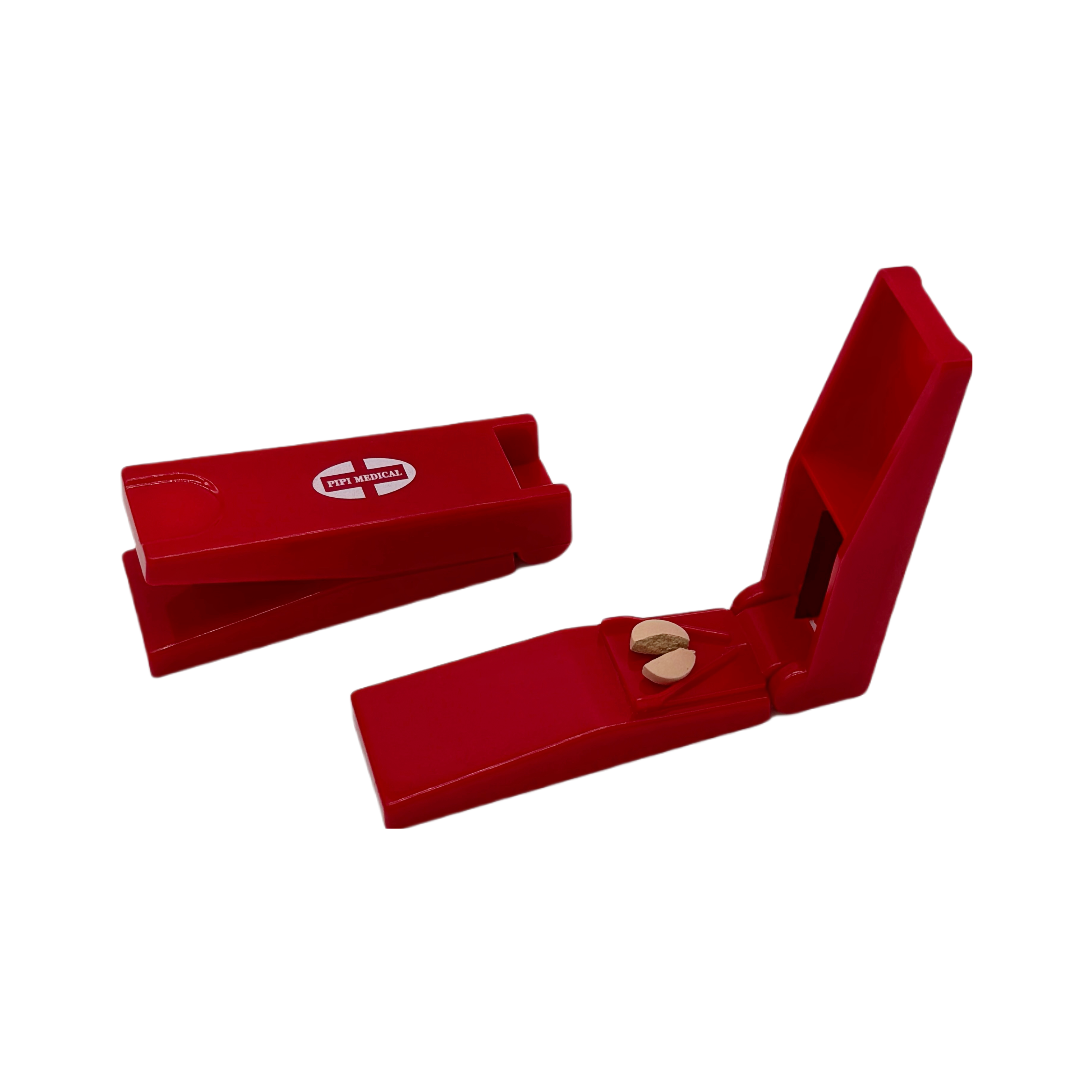
A typical pill cutter consists of a housing, a blade, a tablet-holding compartment, and a hinged lid. The user places the tablet inside the compartment and closes the lid, allowing the blade to pass through the tablet. Although the mechanism appears simple, each part can influence cutting stability and ease of use.
The tablet-holding compartment is particularly important. If it is too large, the tablet may move during cutting. If it is too small, it may not accommodate larger tablets. A V-shaped or tapered holder can accept round tablets of different diameters and guide them toward the center, helping reduce movement and misalignment.
For oval, oblong, or irregularly shaped tablets, purchasers should check whether the compartment provides sufficient space and holds the tablet securely. No single holder design is suitable for every tablet, so the intended tablet shapes and sizes should be considered when selecting a model.
Why Does Blade Quality Matter?
The blade is the central component of a pill cutter. Stainless steel is commonly used because it offers suitable hardness, durability, and resistance to corrosion. The blade should be securely installed and sufficiently sharp to cut through a tablet smoothly, reducing the need for repeated pressure and helping limit excessive crumbling.
Blade alignment is just as important as sharpness. If the blade does not align with the center of the tablet holder, a correctly positioned tablet may still be cut off-center. For projects with higher quality requirements, purchasers should assess blade sharpness, installation stability, alignment, and performance after repeated use rather than checking only whether the product can complete a single cut.
Even a well-designed pill cutter cannot guarantee that every tablet will be divided into two perfectly equal portions. Tablet hardness, thickness, shape, score line, and formulation can all influence the result. A pill cutter is intended to improve convenience and splitting consistency, but it does not replace professional medication advice.
What Should Purchasers Look for in the Housing Material?
Pill cutter housings are commonly made from ABS, PP, or other plastic materials. A suitable housing should provide adequate structural strength and should not crack or deform noticeably under normal pressure. The edges should be smooth, and the lid should open and close without excessive resistance.
A transparent or semi-transparent lid allows users to see the position of the tablet and check whether it is aligned with the blade. For older adults or people with limited hand strength, a larger pressing surface and an easy-to-grip shape may provide a better user experience. For portable use, a compact design with a secure closure can help prevent the device from opening accidentally.
Purchasers should also verify whether the materials meet the requirements of the intended market. Material safety, durability, odor, and surface finish should all be evaluated. For long-term or private-label programs, consistent material quality across different production batches is equally important.
Which Pill Cutter Is Suitable for Each Application?
A basic pill cutter is compact and straightforward, making it suitable for users who only need to divide tablets. Models with an integrated storage compartment can temporarily hold a small number of tablets or split portions, which may be convenient for travel and everyday use. However, medication storage should always follow the instructions provided with the medicine.
For users who need both tablet cutting and crushing functions, a multifunctional model may be more practical. These products combine several functions in one unit, reducing the need to carry separate devices. Each function should still be evaluated independently, particularly the ease of operating the crushing mechanism, the fineness of the resulting powder, the amount of residue left behind, and the ease of cleaning.
Hospitals, pharmacies, and care facilities may place greater emphasis on product reliability, cleaning requirements, and batch consistency. Retailers and private-label brands may also prioritize appearance, packaging, and portability. Identifying the primary users and sales channels before selecting a model can help purchasers avoid unnecessary features and choose a more suitable product.
Is the Pill Cutter Easy to Clean and Maintain?
Tablet powder and fragments may remain around the blade, holder, or lid after use. Products with numerous narrow gaps can be more difficult to clean, while a relatively simple and accessible internal structure usually makes residue removal easier.
A pill cutter should be cleaned according to the manufacturer’s instructions and allowed to dry before it is used again. Fingers should not come into direct contact with the blade during cleaning. If a healthcare facility intends to use the same device for different individuals, it should follow its internal cleaning and infection-control procedures. Where shared use is not appropriate, a dedicated device should be assigned to each user.
What Should Be Confirmed for OEM and Private-Label Orders?
For distributors, importers, and private-label customers, product performance is only one part of the purchasing decision. OEM requirements should be confirmed before production begins. Common customization options include product color, logo application, instruction leaflets, retail packaging, barcodes, and carton configuration.
Labeling, packaging information, and product claims may be subject to different requirements in different markets. Before placing a bulk order, purchasers should confirm the destination market, intended use, required packaging language, and applicable regulatory requirements. Pre-production samples should be reviewed for product color, logo placement, printed information, blade installation, and opening and closing performance.
During final inspection, samples can be selected from different cartons and production batches to check cutting performance, housing integrity, blade position, hinge operation, closure security, and packaging accuracy. For long-term purchasing programs, buyers should also evaluate whether the supplier can maintain consistent materials, colors, construction, and delivery schedules.

Can Every Tablet Be Divided with a Pill Cutter?
Not all tablets are suitable for splitting. Extended-release, controlled-release, enteric-coated, specially coated, and certain other formulations may be affected when cut. Capsules should not be placed in a pill cutter. Dividing an unsuitable medicine may change how it is released, reduce its stability, or create other safety concerns.
Even when a tablet has a score line, users should not assume that it can always be divided. The medicine information should be checked, and a doctor or pharmacist should be consulted before splitting any medication. A pill cutter is an assisting device and should never be used to change a prescribed dose without professional guidance.
How Can Purchasers Make a Better Selection?
A suitable pill cutter should offer a practical balance of cutting performance, ease of operation, safety, and cost. Before choosing a model, purchasers should consider the following factors:
- Whether the holder can securely accommodate the intended tablet sizes and shapes
- Whether the stainless steel blade is sharp, securely installed, and correctly aligned
- Whether the housing has sufficient strength and operates smoothly
- Whether the product is easy to hold, carry, and clean
- Whether storage, crushing, or other additional functions are required
- Whether the materials, labeling, and packaging meet the requirements of the destination market
- Whether the supplier can provide consistent quality, customization, and reliable bulk delivery
A pill cutter may be a small device, but its tablet-holding structure, blade quality, and overall construction can significantly affect the user experience. Selecting a product for a clearly defined application—and completing sample testing and quality verification before bulk purchasing—can help hospitals, pharmacies, care facilities, distributors, and healthcare brands obtain a more reliable pill-cutting solution.
Latest News